
4 Questions to Ask When Decluttering Feels Hard
When it comes to letting go of items in your home, “Do I want this?” isn't always the most helpful question.
If you're already on the struggle bus deciding whether something stays or goes, it's really easy to come up with a bajillion reasons why you "want" it...
I might need it someday.
I spent a lot of money on it.
I should be using it.
It was a gift.
It's a family heirloom.
And around and around we go.
Sometimes the hardest part isn't deciding to keep something or let it go.
It's not deciding at all.
The Limbo Land of Clutter
To me, being somewhere in between is one of the hardest places to be.
We experience this with big decisions in life, but we do it with the little decisions in our homes, too.
Do I want this?
Maybe.
Will I use it?
I might.
Should I get rid of it?
I don't know.
So back onto the shelf it goes.
And technically, nothing bad happens. You can always make the decision another day.
But the decision is still there.
The next time you come across that sweater from high school, you have to decide all over again.
Those non-decisions create mental clutter. Even though you've semi-decided to deal with it later, it's still hanging out in the back of your head:
I need to decide what to do with that...later.
I had my own version of this with knitting.
When I lived in Bellingham, I used to knit with a group of girlfriends. We'd get together and knit, and I loved it. I made hats, attempted a pair of slippers for my mom, and created some really beautiful things I was proud of.
And then I moved to Los Angeles.
All of my yarn and knitting needles came with me. I had them in a knitting basket, and I loved looking at it. Yarn is BEAUTIFUL. All those colors and textures and the endless possibilities of what I could make with it?!
But I wasn't knitting.
Part of what I'd loved about knitting was doing it with my friends. If I dropped a stitch or got lost in a pattern, someone could help me figure it out. Without that group, knitting wasn't the same.
Could I have watched YouTube videos when I got stuck? Absolutely.
Could I have found a knitting group in LA? Yep.
Was I actually going to do either of those things?
Nope.
Still, that basket stayed in our apartment for almost a year.
Every time I looked at it, I remembered how much fun I'd had knitting with my girlfriends and how proud I was of the things I'd made. But it also reminded me that I wasn't knitting anymore.
I loved knitting.
I should knit again.
Maybe I'll get back into it.
I spent money on all this yarn.
Some of this was my grandma's.
I kind of wanted to knit again...but not really. Because what I actually missed was knitting the way I'd done it in Bellingham.
Eventually, I realized I wasn't going to knit anytime soon, and I didn't want the basket, yarn, and needles taking up precious space in our small LA apartment while I kept debating whether I'd use them again.
So I made a decision.
That part of my life was closed for right now.
I gave the yarn to my sister-in-law, who was knitting at the time, and once it was gone, I didn't miss it. I didn't have to figure out where to store the basket anymore or have the same conversation with myself every time I looked at it.
And letting go of the yarn didn't erase anything I loved about knitting.
I still made those hats. I still spent those evenings knitting with my girlfriends. I still have those memories.
You don't have to make a decision for forever. Sometimes you just need to make a decision for the life you're living right now.
I've experienced this with much bigger decisions, too.
During the pandemic, when we were living with my mother-in-law, I started helping her declutter and organize different spaces in her home. I came out of that experience thinking, Oh my gosh. I LOVE this. I loved helping make spaces more functional and beautiful, and I started wondering if maybe I should start my own organizing business.
But the idea was also terrifying.
I'd never run a business. How do you find clients? How do you price things? How do you do...any of it?
So instead of forcing myself to decide whether I was ready to start an organizing business, I asked a smaller question:
Are there organizing businesses that are hiring?
I found Tailored Organizing, reached out to the owner, and asked if she was hiring.
She was.
We met, hit it off, and I started working for her. About six months later, she told me she was moving and asked if I wanted to buy the business.
And THAT decision felt very different.
I remember thinking, Oh my gosh. I have to do this. If I don't, I'm going to regret it.
So I bought Tailored Organizing.
I didn't have to figure out how to start a business before I could move forward. I just had to make the next decision that felt doable.
Sometimes getting out of limbo doesn't require answering the biggest question. You just need to figure out the next question you can answer.
I also don't think the goal is to make every decision quickly or force ourselves to get rid of something before we're ready. Sometimes “I'm not ready to decide this yet” is a decision.
But there's a difference between intentionally giving yourself more time and staying stuck because you're waiting to feel 100% certain.
And that's where we get ourselves into trouble.
We're Waiting for Certainty That Doesn't Exist
I recently came across a decluttering question that immediately made me think, WHY HAVEN'T I BEEN ASKING THIS?!
It got me thinking about how much the questions we ask ourselves matter when we're deciding what stays and what goes.
Because sometimes we're asking ourselves questions that don't actually have answers.
Will I ever need this again?
Maybe!
Will I regret getting rid of it?
Possibly!
Will my kids want this someday?
Who knows?!
We can spend a lot of time trying to predict the future before allowing ourselves to make a decision.
But we don't always need certainty to make a decision.
Sometimes we need confidence that we can handle the outcome of the decision.
Maybe you let go of 50 things, and six months from now there's one thing you wish you'd kept.
You can handle that.
You might be disappointed. You might have to borrow another one. You might even have to buy it again.
That doesn't mean you made a terrible decision.
The goal isn't to make the perfect decision every time.
It's to make a thoughtful decision you can live with—and get yourself out of limbo.
So here are four questions I use to help get there.
1. If This Broke Today, Would I Replace It?
Think about it. If the answer is no, that's really useful information.
There are plenty of things we keep simply because we already own them. But if you wouldn't spend your money to bring that item back into your home today, is it something you still need to make space for?
We have a lot of pieces of "good wood" in our home from various projects my husband and I have worked on. We've been keeping them "just in case" we could use them for another project.
But the truth is, our next project could be months or a year from now—and that wood is taking up a lot of space and most likely won't even be the right size for whatever we decide to build next.
SO, we finally decided to let go of most of our bits and pieces of wood, and what a relief we both felt!
We saved some wood we know we'll use for our garden steps and some long pressure-treated beams, but we let the rest go.
Those pieces are no longer reminding us of all the projects we could potentially use them for—or making us ask, Why are we keeping this?
The wood we've kept is neatly stored, out of the way, and has value because we know what we're going to use it for.
This question isn't asking whether an item still technically works or whether you could use it someday.
It's asking whether you'd choose to bring this item into your life again today.
2. If I Needed This Someday, What Would I Actually Do?
Ahhh, the infamous “But what if I need it someday?”
I hear this one all the time.
And here's the thing:
You might.
That's the part we sometimes skip over in decluttering advice. I can't promise you'll never need something again after you let it go.
So instead of trying to convince yourself that you won't need it, follow the “what if” all the way through.
Okay. What if I DO need it someday? Then what?
Could you borrow one?
Do you already own something else that would work?
Could you easily and inexpensively replace it?
Would you be mildly annoyed that you got rid of it—and then move on with your life?
And maybe you realize:
Actually, this would be really difficult or expensive to replace, and there's a decent chance I'll need it.
Great! Keep it.
You're not trying to talk yourself into getting rid of it.
You're trying to make a decision.
“I KNEW I'd Need That!”
And yes, sometimes you're going to get rid of something and then need it.
And your brain will immediately go:
SEE?! I knew I shouldn't have gotten rid of that!
It's pretty rare that I miss something I've donated or thrown away. But when it happens, it's usually more of an annoyance.
Dang it. I got rid of that.
Then I figure out whether I can use something else, borrow one, or replace it if I really need to.
And when I compare that occasional annoyance with how long some things can take up valuable real estate in our homes—not to mention the mental clutter that comes with continually deciding what to do with them—I'm okay with occasionally getting it wrong.
You don't need a guarantee that you'll never need the item.
You need to decide whether you're comfortable with what would happen if you did.
3. Does Seeing This Make Me Feel Good—or Does It Remind Me of Something I Think I “Should” Be Doing?
This is a big one.
The pants that don't fit.
The supplies for the hobby you haven't touched in three years (hello yarn...).
The kitchen appliance you spent good money on and never use.
The stack of books you keep meaning to read.
Sometimes our belongings become physical reminders of all the things we think we should be doing.
Sometimes we're holding onto things for a version of ourselves that doesn't really exist right now. Maybe it's something you used to do, something you thought you'd be doing by now, or something you still think you should want to do.
And sometimes there's guilt mixed in there, too.
I spent so much money on this.
I used to love doing this.
I really should get back into it.
I should read those books.
I should fit into those pants.
But keeping the item doesn't make any of those things happen. Sometimes it just gives the “should” a physical place to live in your home.
Maybe you have a pair of pants you're hoping to fit into again someday. If seeing them motivates you or makes you feel good, great!
But if you open your closet every morning and those pants make you feel crappy about yourself, that's not a great way to start your day.
The goal can stay, even if the pants don't.
Letting go of something doesn't mean you're giving up on the goal it represents.
Your home doesn't need to be a storage space for your “shoulds.”
And if the item does still represent something you genuinely want for yourself? Keep it!
The point isn't that anything connected to a past or future version of you needs to go. It's figuring out whether seeing it feels hopeful and useful—or whether it's just making you feel bad.
4. Am I Attached to This Item—or What It Represents?
Sentimental items can be some of the hardest things to declutter.
Maybe it's been passed down through your family for generations—but you don't actually like it.
Maybe it belonged to someone you love.
Maybe it was a gift.
Maybe it reminds you of a specific person, place, or time in your life.
Sometimes we're not particularly attached to the thing at all.
We're attached to what it represents.
And figuring out the difference can be really helpful.
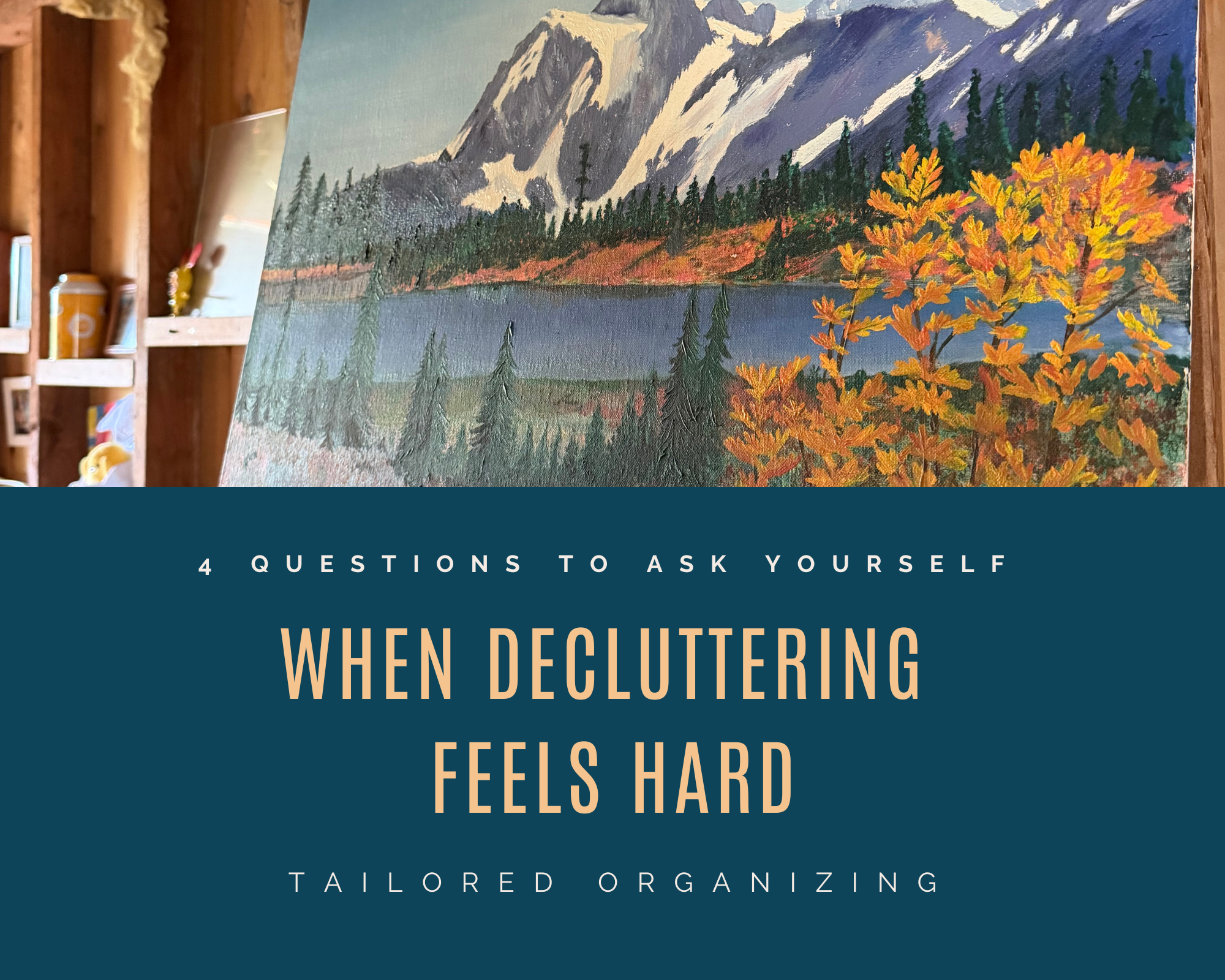
My grandmother was an artist, and she painted the most beautiful paintings. She was pure magic to me. (Both of my grandmas were—I was a very lucky child.)
When she died, each grandchild got to choose one of her paintings to keep. I chose a landscape she had painted of Mt. Shuksan in Washington State.
My parents held onto it for me while I bounced around apartments during my college years, and when I eventually moved to LA, the painting came with me.
It didn't really fit with Morgan's and my aesthetic.
But I didn't care.
That painting reminds me of my grandma and how much beauty she brought into the world. I still have it today. It isn't front and center in our home, but it's somewhere I can see it—and when I do, it makes me smile and warms my heart.
So it stays.
That's a very different decision from the yarn.
Some of that yarn had belonged to my grandma, too. I let it go because I realized I didn't need her yarn to hold onto my memories of her.
The painting is different. I genuinely love having it in my home.
Neither decision is more correct than the other.
You don't have to keep something just because someone you love owned it or because it's been in your family for years.
And you also don't have to get rid of something just because you don't use it.
Sentimental value is a perfectly good reason to keep something.
The goal is to understand why you're keeping it—and decide whether that's a reason that feels right to you.
Getting Out of Limbo
And that's really the point of all of these questions.
Decluttering isn't about getting rid of as much as possible.
It's about making decisions about what deserves to take up space in your home.
Sometimes a better question will make you realize:
Oh yeah. I can absolutely let this go.
And sometimes it will make you realize:
Nope. I actually really want this.
Both are good decisions.
There's a difference between keeping something because you've decided it has value to you and keeping it by default because you couldn't decide what to do with it.
A decided keep closes the loop.
You know why it's there. You've decided it's worth the space it takes up. You don't need to have the same internal debate every time you come across it.
And if you decide to let it go, you close the loop that way, too.
That doesn't mean you'll never second-guess yourself or occasionally wish you'd kept something. We're humans. Of course that's going to happen.
We don't always need certainty to make a decision.
Sometimes we need confidence that we can handle the outcome of the decision.
And maybe that's the real goal here—not making the “right” decision every single time, but trusting yourself enough to make one.
Once You've Decided to Let It Go...
Once you've made the decision to let something go, there's one more decision to make:
Where should it actually go?
Donation is often the obvious answer—but not everything we're ready to let go of is in good enough condition to donate.
Before putting something in the donation pile, ask yourself:
Would I feel good giving this directly to another person?
If it's broken, badly stained, heavily worn, or simply at the end of its useful life, donating it may just mean someone else has to throw it away.
I care a LOT about keeping things out of the landfill, so I always try to find the most responsible next place for something. For worn-out clothing and textiles, for example, I use services like Trashie when appropriate. Other things may need to be recycled or, yes, thrown away.
I know that can feel uncomfortable. I struggle with it, too. But putting something unusable into a donation bin doesn't keep it out of the landfill—it just passes that decision along to someone else.
Sometimes responsible decluttering means being the one willing to say, “This has reached the end of its useful life.”
Need a Little Help Getting Unstuck?
Sometimes having the right questions is enough to get things moving. And sometimes it's a whole lot easier to make these decisions when you have someone there to work through them with you.
If you're in Salem, Keizer, or the surrounding Willamette Valley and you're feeling stuck with clutter in your home, I'd love to help.
Tailored Organizing offers hands-on, nonjudgmental decluttering and organizing support to help you make decisions, create functional systems, and feel more at ease in your space.
Learn more about working with Tailored Organizing
Happy decluttering!
Jen